Fifth issue of the Financial Stability publication released
The Croatian Financial Services Supervisory Agency has published the fifth issue of its Financial Stability publication, providing a detailed analysis of systemic risks and the resilience of the financial services sector. The publication reviews key developments and risks in the insurance, leasing, factoring, investment fund and pension fund industries, as well as in financial markets, considering all segments within the broader macroeconomic environment.
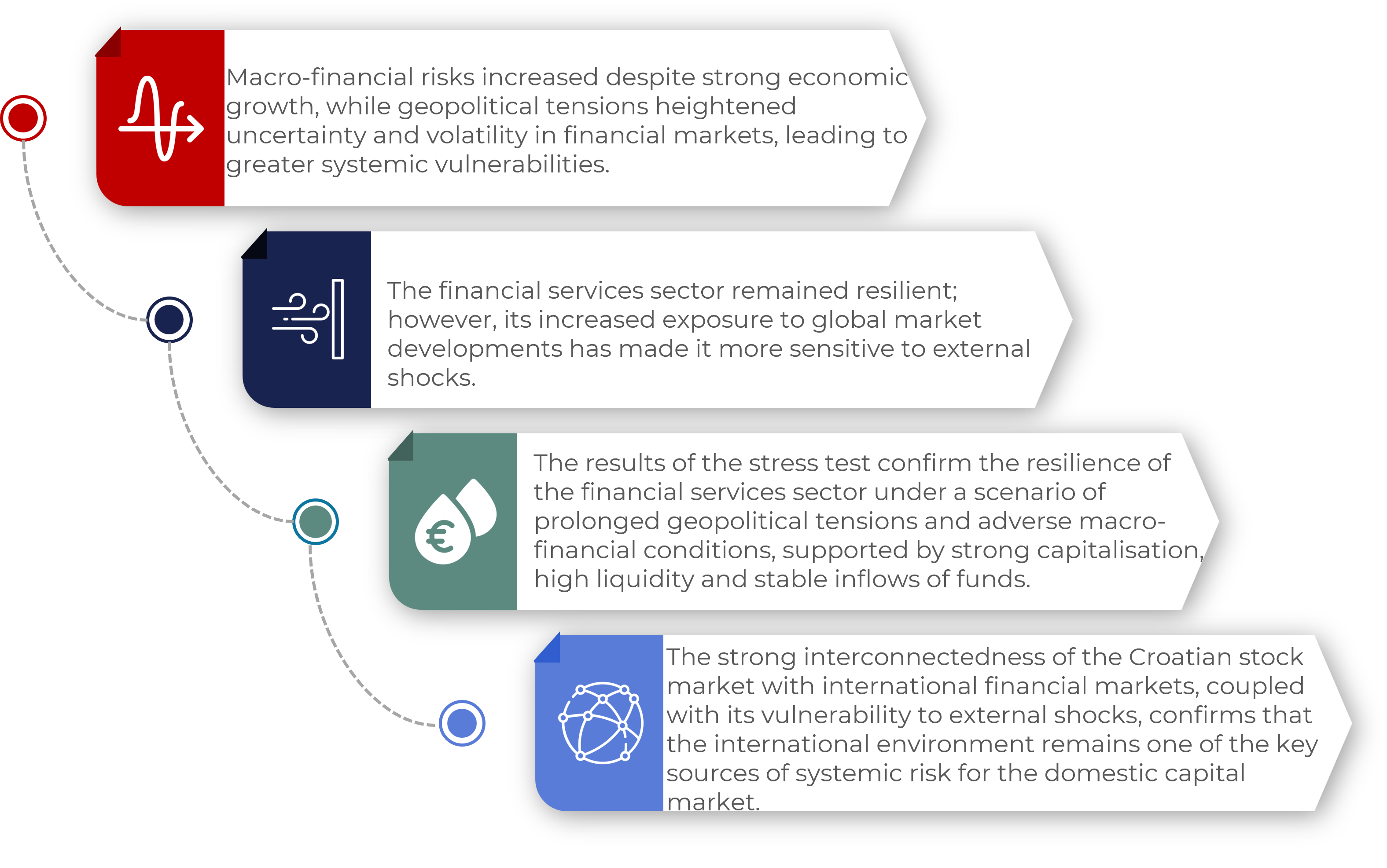
In 2025, macro-financial risks increased further despite the continuation of relatively strong economic growth. Economic activity remained primarily driven by domestic demand and investment, while external imbalances deepened, inflation remained above the euro area average, and residential property prices continued to rise strongly. At the beginning of 2026, the materialisation of geopolitical risks further heightened uncertainty through potential disruptions to energy supplies, stronger inflationary pressures and a deterioration in the economic outlook. Financial markets nevertheless demonstrated a high degree of resilience; however, elevated valuations in global markets, increasing concentration of certain investments and higher volatility point to growing systemic vulnerabilities in the event of a further deterioration in macroeconomic or geopolitical conditions. In the domestic capital market, record levels of regular trading turnover and three new listings were recorded, attracting interest from both institutional and retail investors.
The financial services sector continued to demonstrate strong resilience throughout 2025, maintaining profitability and capitalisation, although its exposure to global market developments has increased its sensitivity to external shocks. Pension funds continued to increase their assets and deliver strong returns while further diversifying their investments and reducing concentration risks. At the same time, their exposure to international financial markets increased. Temporary market volatilities at the beginning of 2026 led to a short-lived decline in the value of pension funds’ assets, but the subsequent rapid recovery confirmed the sector’s resilience. Investment funds also recorded strong growth in net assets during 2025, with money market funds leading the expansion of the sector. A sharp escalation of geopolitical tensions and a surge in financial market volatility temporarily reduced the net assets of UCITS funds in early March 2026, followed by a swift recovery. Insurance companies maintained high levels of profitability, liquidity and capitalisation during 2025, supported by continued premium growth and further improvements in the quality and diversification of investments, while market and interest rate risks remained the sector’s most significant sources of vulnerability. Leasing companies continued to expand their business activities while maintaining low credit risk and satisfactory profitability, with interest rate risk remaining the main source of uncertainty.
The publication also presents the results of a stress test conducted under a scenario involving prolonged geopolitical tensions, disruptions in energy markets, stronger inflationary pressures, tighter financing conditions and a correction in financial asset prices. Such hypothetical shocks would adversely affect asset values, profitability and portfolio quality across most financial service providers, while increasing market and credit risks. Nevertheless, the results confirm that the financial services sector as a whole remains resilient, primarily owing to strong liquidity, sound capitalisation and stable net inflows into pension funds.
A special feature of this issue examines the interconnectedness of the Croatian stock market with international financial markets during periods of heightened uncertainty and shocks. The findings show that the Croatian capital market is highly integrated into the international financial system and acts as a net recipient of shocks from abroad, similarly to markets in most small, open economies in Central and Eastern Europe. The increased interconnectedness of markets during periods of crisis can largely be explained by higher market volatility in foreign markets rather than by financial contagion in the narrower sense. The findings confirm that the international environment remains one of the key sources of systemic risk for the domestic capital market and underline the importance of continuously monitoring cross-border shock transmission channels in macroprudential risk assessment.
The full publication (in Croatian, translation pending) is available here.

